- BRAINTRAIN |
- Blog |
- Brain Development |
- How to Improve Peripheral Vision





Artem Ivanchenko 15.10.2026 5 Comments
For most people, peripheral vision works fine. The weak spot is the brain: it processes what's happening at the edges slowly and reluctantly, especially when your eyes are glued to a screen. You notice the cyclist on your right only when he's already next to you, or you hunt for your keys on a shelf where they're sitting in plain sight. You can't really train your eyes to cover a wider angle, because the limits of the visual field are set by anatomy. What you can train is how quickly your brain picks up on things at the edges, and there's solid research behind that.
What's going on when you see something out of the corner of your eye
Sharp vision covers a surprisingly tiny area. The fovea, the central pit of the retina, handles about two degrees of the visual field, roughly twice the width of your thumbnail held at arm's length. Everything else, around 180 to 200 degrees horizontally, is periphery. Peripheral vision is blurry, poor at color and useless for small print. It is, however, very sensitive to motion and contrast. That's why you can tell something flickered at the edge of your vision but can't say what it was.
Exercises won't push the edges of your visual field any further out. What does change with practice is what researchers call the useful field of view: the area you can pull information from in a single brief glance while your attention is busy with something in the center. It can be wide or narrow regardless of how healthy your eyes are.
That's the part worth training.
What studies of drivers and gamers found
Researchers started studying the useful field of view in the 1990s while looking for reasons older drivers crash. The test works like this: an image flashes in the center of the screen along with another object off to the side. You have to identify the central image and point to where the side object was. The display time keeps getting shorter until you start making mistakes.
ACTIVE, a large randomized trial, produced the best-known result. Older drivers, with an average age of 73, completed up to 10 sessions of speed-of-processing training built around this test. Over the following six years or so, they had roughly half as many at-fault crashes as the control group. That sounds like an ad, but the trial involved hundreds of drivers, and the outcome was counted from real crash records rather than self-reports.
There are caveats that brain-training ads tend to leave out. A group that trained reasoning instead showed a similar drop, so peripheral attention can't take all the credit. One of the authors held stock in the company selling the program. And right after training, participants didn't get better at remembering or reasoning; the gain showed up on the field-of-view test itself.
The effect is narrow. For driving, though, it turned out to be practical.
Video games are the second line of research. Daphne Bavelier and Shawn Green found that regular action game players locate targets more accurately across the whole visual field, in the center as well as in the periphery. Self-selection doesn't explain it away (the idea that attentive people are simply drawn to games). When non-gamers were trained on an action game, their scores went up too. In the first experiment of this kind, about ten hours of play was enough. We've covered the upsides and downsides of gaming for your head in our piece on how computer games affect the brain.
How to improve peripheral vision: exercises worth your time
All of them work on one principle. Your gaze stays on one point while your attention works the edges. Once your eyes start darting around, you're training ordinary visual search instead, which is useful but different. Here are four options, from the simplest to the ones that need space and time.
Schulte table with a fixed gaze
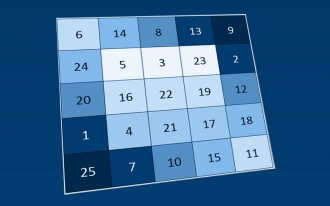
Start with the classic 5x5 grid with the numbers 1 to 25 scattered across it. Most people go through it by scanning cell to cell. For peripheral training the rule changes: keep your eyes on the center cell and find the numbers without looking away from it. The first few times your eyes will keep slipping, and by number 6 or 7 they'll jump to a corner on their own. That's normal. Bring them back and keep going.
How much: 3 to 5 tables per session, about 10 minutes, ideally daily rather than an hour once a week. Write down your time, because without numbers you'll be convinced after a week that nothing has changed. We went through the history of the table and ways to make it harder in our post on building perception with Schulte tables. Once numbers feel easy, switch to the alphabet version of the table so the task gets hard again.
Try it now: one fixed-gaze Schulte table. Note your time. That's your baseline.
The spot on the wall (no screen needed)
Sit down somewhere: a room, a bus, a café. Pick a point in front of you at eye level and look only at it for two or three minutes. Your job is to mentally register everything that changes on either side, who walks past, what lights up, what moves. Then, without turning your head, try to name the colors of objects to your left and right, and check yourself.
Honestly, it's boring.
But it trains the same thing as the useful field of view test, just in the real world with all its movement and mess. One rule with no exceptions: don't do this while driving. On the road your eyes need to keep moving.
Searching the whole field
Here your eyes do move, and that's a different skill, visual search. It's a close neighbor, though. In real life you don't freeze in place, you scan, and the faster your brain filters out what doesn't matter, the fewer eye jumps you need. Tasks where you have to spot a match among many similar objects scattered across the screen work well for this.
In the Dobble trainer, you look at two cards and find the one symbol they share. Play a few rounds and you'll notice the moment you stop checking symbols one by one.
There are more exercises of this kind among the attention trainers on the site. Rotating between them keeps you from getting used to a single format.
Movement, balls and games
Motion is what the periphery responds to best, so training it on the move makes sense. Team ball sports, tennis and table tennis make you track an object while keeping other players in view. Good research on this kind of practice for ordinary people is thin, so I won't promise numbers. As an add-on to screen exercises, though, it beats another hour on your phone.
Action games do seem to work according to the studies, with one obvious problem: it's hard to stop at those ten hours. If you already play, it's good to know the time isn't completely wasted as far as attention goes. I wouldn't take up gaming specifically for your peripheral vision, though.
Speed reading and peripheral vision: where the promises don't match the evidence
Online, the most common promise goes like this: widen your peripheral vision and you'll read a whole line, maybe a whole paragraph, in a single glance. It sounds plausible, but eye-movement research on reading doesn't back it up. According to Keith Rayner's classic findings, a skilled reader takes in information from about 14 to 15 characters to the right of each fixation and 3 to 4 to the left. The rest of the line is a blur as far as the brain is concerned.
That window does vary a little between people. In a study by Rayner and colleagues, fast readers at around 330 words per minute had a wider window than slow readers at around 200. That doesn't mean they had trained their periphery. The window grows as reading skill grows, so it looks more like a result of experience than a muscle you can pump up with tables. The difference is measured in letters, not pages.
That's why I disagree with how Schulte tables are often marketed, as a way to read several times faster. They're good for search speed and steady attention. Reading speed grows from reading itself, from vocabulary and from knowing the subject.
When exercises won't help
If the sides of your vision seem to be getting darker, you keep bumping into door frames, or you miss people approaching from the left or right, see an eye doctor instead of opening a trainer. A narrowing visual field can be a symptom of disease. The best known is glaucoma: it damages the optic nerve, starts at the periphery and stays silent for a long time because central vision remains sharp. Vision lost to glaucoma doesn't come back, which is why early diagnosis matters so much. A visual field test (perimetry) takes a few minutes. It's worth doing during routine eye exams, especially as you get older or if someone in your family has had glaucoma.
How long to give it before judging
A realistic benchmark is two to three weeks at 10 minutes a day. In the studies, effects appeared after several hours of training in total, so one evening won't change anything. Track progress with your time on the fixed-gaze Schulte table and the number of mistakes you make. If the numbers haven't moved after a month, change the format: add the wall exercise, a ball game or a different trainer.
And don't expect to start seeing everything around you like a spy in a movie. Improving peripheral vision, in honest terms, means noticing important things at the side a bit sooner: a car pulling out of a driveway, a ball flying toward you, a friend waving at you in a crowd. For most of us that's plenty. If the bigger issue is that you get distracted easily in general, start with simple ways to stay attentive day to day.