- BRAINTRAIN |
- Blog |
- Memory |
- How Human Memory Works




Artem Ivanchenko 08.07.2026 239 Comments
You can recall the smell of your grandmother's kitchen from childhood, yet you forget where you put your keys five minutes ago. Why?
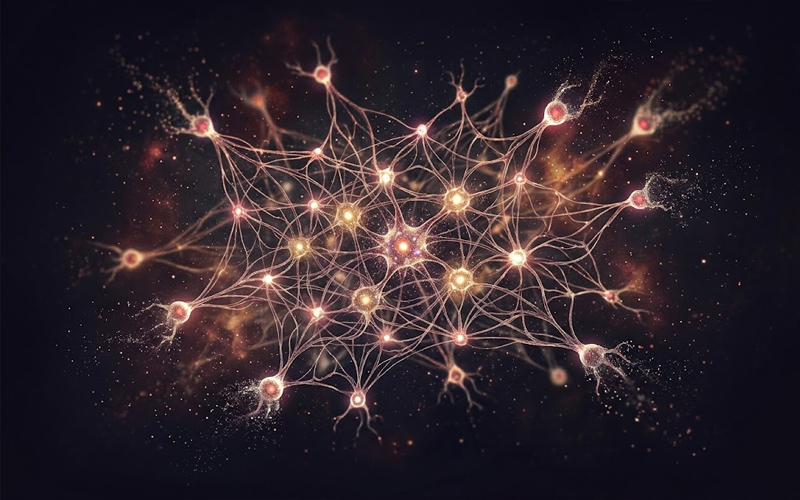
A familiar situation. The brain grips one thing tightly and easily releases another — and it looks like chaos. In reality there is a clear system behind it. To understand how human memory works, you have to stop imagining it as a video camera that records everything. Memory is more like a living structure of billions of neural connections that constantly rebuilds itself. Every memory is not a file on a shelf but a network the brain reassembles each time you recall something.
In this article we break it down step by step: how information enters your head, why some of it stays for years while other bits vanish in seconds, and what you can do about it.
Want to test yourself right now? Try the online brain trainer →
What memory is and how it actually works
Memory is the brain's ability to encode, store and retrieve information. Three key words here: encoding, storage, retrieval. Every memory failure is a failure at one of these three stages, not some abstract "bad memory".
On a physical level a memory is a pattern of connections between neurons. When you experience something for the first time, a group of nerve cells fires together. If it repeats, the links between them strengthen. Neuroscientists describe it with the phrase: "neurons that fire together, wire together." That is why what you live through or repeat many times holds firm, while a random detail disappears.
We covered the concept itself in more detail in the article What Is Memory — here we focus on the mechanics of the process.
Three types of memory: sensory, short-term, long-term
Memory is not a single thing. It is several systems working on different time horizons.
Sensory memory. The shortest. It is the trace of what you just saw or heard — it lives for fractions of a second. As you scan a room with your eyes, each frame lingers for a moment. Almost all of it is erased instantly, because there is no point in the brain storing every picture.
Short-term memory. Here information holds for seconds to minutes. The classic example is a phone number you repeat in your head until you dial it. Its capacity is tiny: a person holds about 4–7 items at once. That is why a long password without a note is not memorized on the first try.
Often working memory is singled out separately — it is short-term memory in action, when you don't just hold data but do something with it. Calculating a tip in your head, weighing two arguments in a conversation, remembering the start of a sentence while you finish it — all of this is working memory.
Long-term memory. A practically limitless store. Here lie your name, how to ride a bike, the capital of France and the memory of your first day at school. Information does not arrive here automatically — it has to go through a consolidation process, covered below.
Long-term memory is also split: into explicit (facts and events you can consciously name) and implicit (bodily skills — swimming, touch-typing, driving). That is why you don't forget the skill of driving for years, even if you haven't been behind the wheel.
How the brain memorizes: three stages
For information to settle in for the long haul, it passes through three stages. Let's break down each.
- Encoding. The brain turns what you perceived into an internal signal. Attention plays the decisive role here. Without attention encoding barely happens — that is why you "read" a page while thinking about something else and remember nothing. This is not a memory problem, it is an attention problem at the input.
- Consolidation. A fresh trace is fragile. For it to strengthen, it needs time and — critically — sleep. During sleep the brain rewrites the day's impressions from temporary storage (the hippocampus) into long-term storage (the cortex). That is why a sleepless night before an exam is the worst strategy: the material simply doesn't have time to lock in.
- Retrieval. Remembering is not reading a ready-made file. The brain reassembles the memory anew from fragments each time. And here lies an important detail: every retrieval slightly changes the memory itself. That is why witnesses to a single event remember it differently over the years.
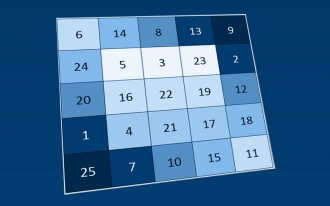
The weakest link for most people is retrieval. The information is in your head, but pulling it out at the right moment doesn't work. This is trained simply: by active recall. Don't reread — try to remember. Spatial-memory games load exactly this mechanism — holding and reproducing positions from memory.
The best way to improve your result is practice. Start training right now →
Why we forget
Forgetting is not a malfunction. It is a function. If you remembered every detail of every day, the brain would drown in noise. So it actively filters out what goes unused.
The German psychologist Hermann Ebbinghaus described the "forgetting curve" back in the 19th century. The point is simple: we forget the most in the first hours after learning. Without repetition, up to half of new material evaporates within a day. But each repetition flattens the curve — the memory holds longer and longer.
The main reasons information disappears:
- Weak encoding. You weren't attentive at the input, so no strong trace formed in the first place.
- Lack of repetition. The brain decides the information is unnecessary and removes it.
- Interference. New knowledge overlaps old and overrides it. A new password crowds out the old one.
- Access problems. The memory exists, but the "hook" to pull it out is lost. The classic "on the tip of my tongue".
Tips: what helps memory and what hurts it
Memory is not an innate constant. Its performance can be noticeably improved with everyday habits.
What helps:
- Sleep 7–8 hours. This is not about rest but about the physical consolidation of memory. Sleep deprivation hits consolidation directly.
- Spaced repetition. Don't repeat everything at once — do it at growing intervals: after an hour, a day, a week. This moves material into long-term storage with minimal effort.
- Active recall. Instead of rereading — close the text and try to reproduce it. The effort to remember is exactly what strengthens the trace.
- Associations and images. The brain holds vivid and connected things better. Tie dry information to an image, a story or an already familiar fact.
- Movement and oxygen. Physical activity improves blood supply to the brain and promotes the growth of new neurons in the hippocampus.
What hurts: chronic sleep deprivation, constant stress (the hormone cortisol literally harms the hippocampus), multitasking that scatters attention at the encoding stage, and the habit of googling right away instead of trying to remember yourself — the brain gets out of the habit of working.
Common mistakes that destroy memory
People "train" their memory ineffectively for years because they repeat the same mistakes.
- Cramming the last night. No sleep means no consolidation. What you learned will fall out of your head within a day.
- Passive rereading. You reread it five times and it feels like you know it. That is an illusion of familiarity, not memory. The check: try to retell it without the text.
- Trying to memorize everything at once. Short-term memory holds 4–7 items. Loading a list of 30 points into it is pointless — break it into groups.
- Studying amid noise and notifications. Every switch of attention kills encoding. Memory forms where there is focus, not where a feed plays in the background.
- Expecting it to "memorize itself". Without repetition and attention the brain filters information out as unnecessary. Memory is a process, not a gift.
By the way, many of these mistakes are rooted not in memory but in attention. Improve attention and you automatically improve encoding.
Regular training gives the best effect. Start today →
Frequently asked questions
Can memory be improved in adulthood?
Yes. The brain retains neuroplasticity throughout life — the ability to build new connections. Regular load, sleep and proper repetition techniques deliver results at any age, though it happens a bit faster in youth.
How much information does short-term memory hold?
On average 4–7 items at once and only a few dozen seconds. To hold more, data is grouped into meaningful chunks — that is how a phone number is remembered not as 10 digits but as three or four groups.
Why do I remember childhood but forget yesterday?
Emotionally rich and repeatedly recalled events are firmly consolidated. The brain doesn't consolidate routine trifles because it sees no value in them. It is not about the date but about the strength of the trace and the number of repetitions.
Do brain trainers really help memory?
They train specific mechanisms — holding, encoding, retrieval. The effect transfers to similar tasks. The combination works best: trainers plus sleep, movement and active recall in daily life. Choose the direction you need in the memory trainers section.
Conclusion
Now you know how human memory works not on the level of metaphors but in essence: information is encoded, consolidated during sleep and reassembled anew every time. Memory is not a store of ready-made recordings but a living process you genuinely influence.
The main takeaway: memory doesn't weaken on its own but because of sleep deprivation, a lack of attention at the input and the absence of repetition. Remove these three causes — and the result will change within a few weeks. And to reinforce the skills, read also How to Train Your Memory Every Day and add regular load to your daily routine — without it memory does not work.