- BRAINTRAIN |
- Blog |
- Attention |
- How Not to Get Distracted at Work: 9 Ways to Gather Your Focus





Artem Ivanchenko 02.06.2026 1098 Comments
The average office worker switches between tasks every three minutes. And to dive back into work after an interruption, the brain needs up to 23 minutes.
You sit down for an important task. You open the document, place the cursor. And suddenly your hand reaches for the phone on its own. A minute later you are somewhere in a feed, even though you swore you would not do this. Sound familiar? The question of how not to get distracted at work torments almost everyone who works at a computer. The good news: concentration is not an innate talent but a skill. You can train it like a muscle. Let us break down why focus disappears and what to do about it today.
Want to test yourself right now? Try the online brain trainer →
Why we get distracted at work so easily
The brain hates boredom. When a task is hard or monotonous, it looks for something to reward itself with. And it finds it — a notification, a tab, a thought about lunch.
Behind every switch is dopamine. Each new message gives a small dose of pleasure, and the brain quickly gets used to these micro-rewards. The problem is that deep work gives no reward right away — the result comes later. So the brain chooses the short dopamine loop over long concentration.
The second reason is overload. When five things are spinning in your head at once, attention scatters between them and holds on to none. This is not laziness. It is an overtired system that does not know how to filter out the noise.
Prepare your space: removing distraction triggers
The simplest way not to get distracted is to remove what you get distracted by. It sounds obvious, but this is exactly where most people give up.
- Phone — in another room. Not face down on the desk, but physically away. Studies show that the mere presence of a smartphone in your field of view reduces cognitive resources, even when it is turned off.
- Close extra tabs. Every open tab is an invitation to click into it. Leave only what you need for the current task.
- Turn off notifications. All of them. Email, messengers, banking. What is truly urgent will reach you. The rest can wait.
- One screen — one task. If you are writing text, only the text should be on the screen.
This is the foundation. Without it, any focus technique will work at half power.
Which focus techniques actually work
Now to the tools. Not all are equally useful, but these three are time-tested.
Pomodoro. 25 minutes of work, 5 minutes of rest. The timer creates a deadline, and a short distance does not scare the brain. It is hard to force yourself to work "all day," easy to work "just 25 more minutes."
Time blocking. Plan your day not as a to-do list but as blocks in the calendar: 9 to 11 — the report, 11 to 11:30 — email. When every task has its own window, the temptation to grab everything at once disappears.
The two-minute rule. If the thought "I need to reply to a friend" pops up during work — do not drop the task. Write it on a sticky note and come back later. Accumulate small chores instead of doing them on the fly.
And one more thing. The first 10 minutes of any task are the hardest. The brain needs to "warm up." If you hold through that start, it gets easier afterward.
The best way to improve your result is practice. Start training right now →
How to train attention so you stay focused longer
Techniques organize the work. But there is a second level — a trained ability to hold focus. You develop it the same way you build strength in the gym: with regular load.
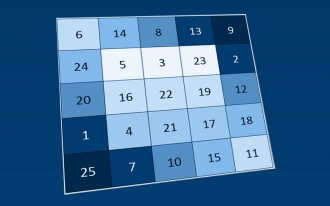
The classic tool here is the Schulte table: you search for numbers in order within a grid without moving your eyes chaotically. This trains peripheral vision and the ability to concentrate on a task despite distracting elements. Exercises for fast search and filtering help too — they teach the brain to single out the right object among similar ones and switch between criteria without losing speed. These are exactly the skills you lack when attention "falls apart." A whole set of such exercises is gathered in the attention trainers section.
10–15 minutes a day. After 3 weeks you will notice you stay on a single task longer and reach for your phone on autopilot less often.
Tips: what helps and what gets in the way
Briefly about what really affects concentration.
Helps:
- Sleep of 7–8 hours. Lack of sleep hits attention harder than anything else.
- Water and breaks. A dehydrated and stiff brain does not focus.
- One task at a time. Multitasking is a myth; the brain just switches quickly and gets tired.
- A clear start. Define exactly what you must do in the next 25 minutes.
Gets in the way:
- Working with a social feed "in the background." There is no background — the brain switches anyway.
- Vague tasks. "Work on the project" is not a task but an excuse to postpone.
- Constant readiness to reply. If you are waiting for a message, you are already partly absent.
Mistakes that make you lose focus
Even with good intentions it is easy to take a step back. Here are the typical traps.
- "I will just take a peek." One glance at the phone breaks the entire state of immersion. Remember those 23 minutes it takes to return.
- Working without breaks. Heroic three-hour marathons without a pause end in burnout by lunchtime. Rest is part of the work, not a reward for it.
- Trying to do everything perfectly on the first pass. Perfectionism paralyzes. Draft first, polish later.
- Ignoring your biorhythms. Everyone has peak hours. Do not schedule creative work for the time when the brain wants to sleep.
Noticing these mistakes is already half the battle. The other half is trained attention that does not let a minor irritant knock you off course.
Frequently asked questions
How long does it take to learn not to get distracted?
The first changes in how you organize work are felt immediately — as soon as you remove the phone and turn off notifications. A trained ability to concentrate grows longer: a noticeable effect usually appears after 2–4 weeks of regular exercises of 10–15 minutes a day.
Is it true that people cannot do several things at once?
Yes. The brain does not perform two conscious tasks in parallel — it switches quickly between them. Each switch costs energy and attention, so "multitasking" actually lowers both the speed and quality of work.
What to do if an intrusive thought keeps pulling you away from work?
Write it down. When the thought "do not forget to do X" is fixed on paper, the brain stops holding it and lets it go. You will return to the list after the work block.
Do music and white noise help or hinder?
It depends on the task and the person. For monotonous work, background sound often helps to cut off external noise. For text or analysis, silence or music without words is better — words compete for the same language area of the brain.
Conclusion
The question of how not to get distracted at work is not solved by willpower in a single day. It is a three-level system: remove the triggers, organize the work with techniques like Pomodoro and time blocking, and train attention itself in parallel. Each level reinforces the others. Start with the simplest — take the phone to the next room right now. Then add 10 minutes of exercises a day so that focus grows stronger week after week.
Regular training gives the best effect. Start today →
Read also: How to Be Attentive and Top 5 Habits for Concentration.