- BRAINTRAIN |
- Blog |
- Thinking |
- Matchstick Puzzles: How to Move a Matchstick and Solve the Equation




Artem Ivanchenko 10.06.2026 1765 Comments
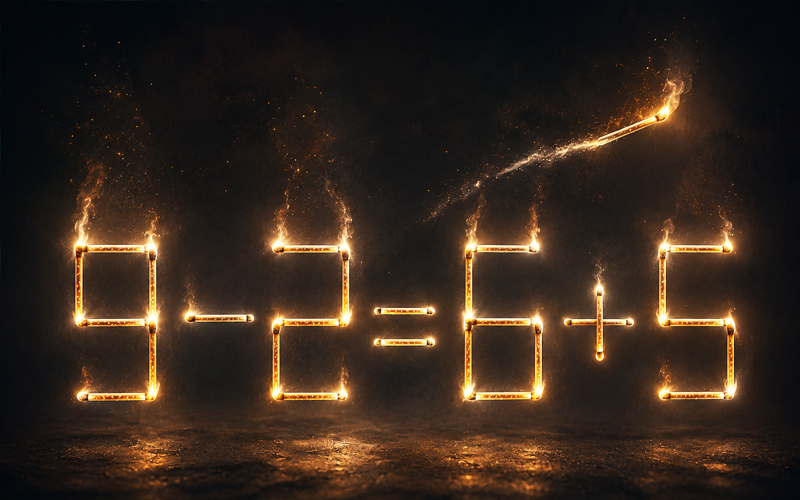
You see 9 − 7 = 12 on the table, laid out in matchsticks. Obvious nonsense. But you are only allowed to move one match. And suddenly your brain stalls.
Sound familiar? Matchstick puzzles look like a kids game until you actually sit down to solve them. A simple wrong equation, one legal move — and the answer refuses to come for five minutes. That is the whole charm: matchstick puzzles force your brain to work in a way it is not used to. Not to calculate, but to see shape. In this article we break down how to solve them without blind guessing, show examples with answers, and the typical traps almost everyone falls into.
Want to test yourself right now? Try the online brain trainer →
What matchstick puzzles are and why they are not so easy
A classic task looks like this: an arithmetic equation is laid out in matches, but it is false. For example, 6 − 4 = 3. Your job is to move exactly one match so the equation becomes true. Adding or removing nothing. The total number of matches is always preserved.
You would think, where is the difficulty here. Right here.
Each digit is built like on a digital display — from seven short segments, the same ones you see on a calculator or a microwave. When you take one match off one digit and place it on an empty spot in another, the digit changes. A six becomes a five, a nine becomes a five, a one turns into a seven. And this is exactly where the brain glitches: we are used to working with numbers as values, but here you have to see them as a set of sticks.
That is why these matchstick puzzles exercise a completely different kind of thinking — spatial, not arithmetic. A schoolkid and an adult are often on equal footing here.
How to solve matchstick puzzles: a working method
Most people rush to guess. They stare at the example and wait for the answer to just pop into their head. Sometimes it does. More often it does not. There is a more reliable way.
Here is a sequence that works almost every time:
- Measure how wrong the example is. 6 − 4 = 3, but it should be 2. The gap is one. That hints at how far you need to shift one of the parts.
- Remember what moving one match does. It is always two actions at once: one digit (or sign) loses a segment, another gains one. So exactly two spots change.
- Run through what each digit can turn into. Mentally remove a segment: 6 without the bottom-left is 5. 9 without the top is 5 or 3. 8 easily becomes 6, 9 or 0.
- Do not forget the signs. Often the solution hides not in the digits but in the operator. Remove the vertical stick from a plus and you get a minus. And vice versa.
Back to 9 − 7 = 12. We measured: 9 − 7 = 2, but it says 12. A big gap, the digits alone probably will not save us. Look at the sign. If you take the top match off the nine, it becomes a five, and that match completes the plus from a minus. You get 5 + 7 = 12. Correct. One move and it all fits.
Notice the key thing? The answer came not from the digits but from the digit-plus-sign combination. That is the mental flexibility we already mentioned in the piece on methods for developing thinking: the ability to let go of the first obvious idea and look from the side.
Examples with answers: practising moving a match
Let us work through a few simple tasks to lock in the principle. In all of them we move exactly one match.
- 1 + 1 = 3. Wrong, since 1 + 1 = 2. Take the bottom segment of the three, move it — and the three becomes a two: 1 + 1 = 2.
- 5 + 1 = 4. Here 5 + 1 = 6, not 4. Change the first digit: remove one segment from the five, turn it into a three: 3 + 1 = 4.
- 6 − 4 = 3. It should be 2. Move a match so the three becomes a two — 6 − 4 = 2.
See the pattern? A single task often has several paths: you can fix the left side, the right side, or the sign. So it pays not to stop at the first solution but to ask yourself: how else?
In the Matchsticks trainer such examples are generated automatically and endlessly — from single-digit to two-digit, with addition and subtraction. And the generator builds the task in reverse: first it composes a correct equation, then makes a few moves out of it. So a solution is guaranteed to exist — there are no dead-end tasks.
Tips: what helps and what gets in the way
Over years of these tasks a few working principles have piled up. And a few things that only slow you down.
What helps:
- Seeing a digit as a set of segments, not as a number. This is the main skill here.
- Checking the sign on par with the digits. Plus ⇄ minus is the most commonly missed move.
- Starting with how wrong the example is. A small gap usually means a digit fix. A big one — look for the sign.
- Taking breaks. If you are stuck for two minutes, look away. A fresh glance often sees the answer in a second.
What gets in the way:
- Trying to recalculate the example instead of rebuilding it. This is not an arithmetic task.
- Fixating on the first idea. If the obvious move does not work, drop it, do not force it.
- Rushing. On a phone it is easy to drag the wrong match and break your own logic.
Common mistakes when solving
Almost everyone trips over the same rake. Here it is.
They try to add or remove a match. The classic trap. The rule says move, not add. The number of matches is fixed: take one away, put one back.
They forget the operator. A person spends an hour twisting the digits, when the answer was to turn a plus into a minus. The sign is matches too, and you can work with it.
They see only one option for a digit. A six can become a five, but an eight can become a six, a nine, a zero, even nothing if you just remove a segment. Run through them all.
They give up too soon. These tasks are deliberately non-obvious. If the answer came in two seconds, it is either an easy level or you are a genius. Thinking for a few minutes is normal.
How matchstick puzzles train your thinking
This is not just a way to kill time in a queue. Matchstick riddles engage several skills at once, and that is their value as a brain trainer.
Spatial thinking. You literally learn to see an object as a sum of parts and rearrange them in your head. The same skill an engineer, a designer or a chess player needs.
Flexibility and option search. The solution almost never lies on the surface. You have to abandon the first idea and look for another angle — what psychologists call overcoming functional fixedness.
Mental arithmetic. You check each option arithmetically, and you do it fast and many times. A decent warm-up if you want to keep your mental math sharp.
If you want to systematically build up logic, there are other thinking trainers too — for example, Molecular Code for spotting patterns. And on how the creative side of the brain works, we wrote in detail in the article on developing creative thinking.
Frequently asked questions
How many matches can you move?
By default one. In harder modes, two. You cannot add or remove matches: their count is always preserved, you only rearrange them.
Do matchstick puzzles always have a solution?
Yes, if the task is built correctly. In a good generator the example is built from an already correct equation by reverse moves, so a solution is guaranteed to exist within the required number of moves.
Can you change a plus into a minus?
Yes. The sign is made of matches too: remove the vertical stick from a plus and you get a minus, and vice versa. Often this is exactly where the solution hides.
How are matchstick puzzles useful for children?
They develop logic, spatial thinking and mental arithmetic in a game format, without rote learning. They suit schoolkids and adults equally — the difficulty levels are easy to adjust.
Conclusion
Matchstick puzzles are a small trainer disguised as a kids game. The secret to solving them is simple: stop calculating and start seeing digits as a set of sticks, check not only the numbers but the signs, and do not cling to the first idea. A few weeks of regular practice and what once took you five minutes you will solve in seconds. And the best way to learn is by doing: open the trainer and solve a few examples right now.
Read also: How to be attentive.