- BRAINTRAIN |
- Blog |
- Brain Development |
- Why TikTok Destroys Attention and How to Get Focus Back


Artem Ivanchenko 21.05.2026 1305 Comments
You open TikTok for 5 minutes. An hour later, you realize you remember nothing — but you can't stop.
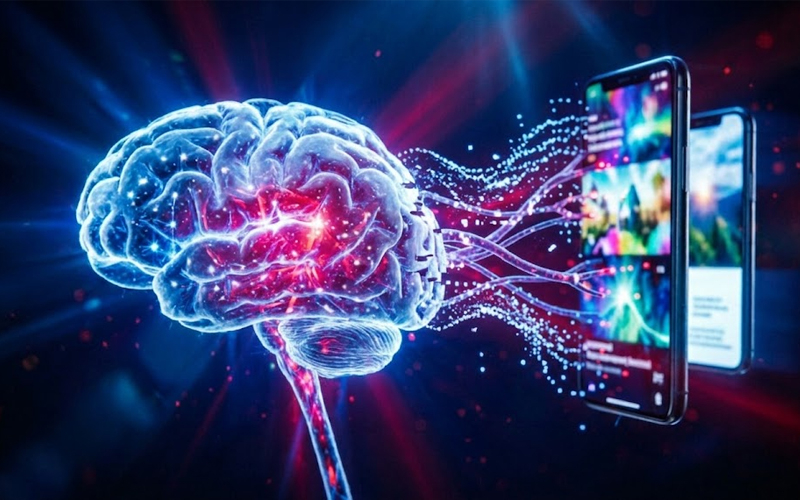
If reading a book for more than 10 minutes has become physically unbearable, it's not laziness. TikTok destroys attention not metaphorically, but literally: it rewires neural connections and teaches your brain to expect a quick reward every 8 seconds. The more you scroll, the harder it gets to focus on anything longer than half a minute.
In this article we'll break down what exactly happens to your brain, why it's not "just a habit," and how to bring your concentration back.
Want to test yourself right now? Try the online brain trainer →
How the dopamine loop of short videos works
It all starts with the neurotransmitter dopamine. It's not the "happiness hormone," as often written. Dopamine is the anticipation molecule. It's released not when you receive something pleasant, but when you predict you're about to.
Now look how this works in TikTok:
- You swipe and don't know what comes next
- The algorithm serves something probably interesting (it trained on billions of swipes)
- Your brain gets a dose of dopamine from the surprise
- You swipe again to repeat the feeling
This is the same mechanism as slot machines. The principle of variable reward is the most powerful way to form addiction known to psychology. You never know if the next video will be great, so you keep scrolling.
After 30 minutes of this, your brain's baseline dopamine level drops. Anything that doesn't deliver the same spike — a book, a lecture, a work report — feels boring. Your brain isn't broken. It just retuned to a new standard of stimulation.
What happens to attention on a physiological level
Concentration isn't "willpower." It's the work of the prefrontal cortex, which suppresses competing stimuli and holds focus on one task.
When you train your brain on 15-second videos for years, here's what happens:
- The "attention window" shrinks — the time your brain can hold one object without switching
- Tolerance for boredom drops — boredom becomes not a neutral state but a sharp discomfort
- Working memory weakens — you can't hold information because you're constantly getting new input
- Anxiety grows — the brain expects constant stimuli and starts to panic without them
A 2023 University of California study showed that people who spend more than 90 minutes a day in short videos perform 23% worse on tests of sustained attention. For schoolchildren, this is even worse — up to 41%.
The unpleasant part — the effect is partially reversible, but not instantly. A few days of detox won't bring back your ability to read for two hours straight. It takes weeks of systematic work. We've already covered how to be attentive in everyday life — the basics are there.
Why "just delete TikTok" doesn't work
Sounds logical: the problem is the app, delete the app. But there's a catch.
If you've scrolled short videos for 3 hours a day for 2 years, your brain has already learned to expect a dopamine spike every 8-15 seconds. Deleting the app doesn't return the brain to its previous state. It just looks for a substitute: YouTube Shorts, Instagram Reels, Twitter threads, constant watch notifications.
And here's where it gets interesting. Most people return to TikTok within a week after deleting it — because the brain suffers from "dopamine hunger." Everything seems gray and boring. That's a normal reaction, but you have to ride it out.
Stop. Let's figure out what actually works.
The best way to improve results is practice. Start training right now →
Advice: what helps restore attention
What helps
- Gradual reduction, not cold turkey. If you scroll 3 hours, start with 1.5. After a week — 45 minutes. The brain will handle this better
- "A boring hour" every day — time without any screens or stimulation. You can walk, wash dishes, lie around. The goal is to restore tolerance for boredom
- Long-form content — 2-hour films, longreads, podcasts. This trains the "muscle" of holding attention
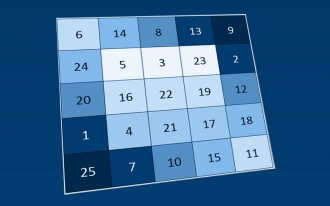
- Cognitive trainers with measurable results — for example, the Schulte Table or attention trainers. You see concrete numbers and progress
- 7-8 hours of sleep. The prefrontal cortex without sleep works worse than after two glasses of wine
- Physical activity — 30 minutes of cardio a day improves concentration after 3-4 weeks
What hurts
- Keeping your phone on your desk (even face down)
- Checking messages every 5 minutes — same mechanism as TikTok, just a different wrapper
- Listening to music with lyrics during complex work — the brain involuntarily processes the words
- Doing several things at once. Multitasking is a myth, the brain just switches quickly and loses energy on each switch
- Caffeine after lunch — disrupts sleep, and bad sleep kills next-day concentration
Mistakes almost everyone makes
Over years of watching people fight short-video addiction, we see the same mistakes:
- "I'll just watch one video" — that's self-deception. The TikTok algorithm is specifically built so you don't stop. Better not to open it at all
- Swapping TikTok for YouTube Shorts — same format, same effect. Just a different logo
- Trying to read a book right after scrolling — the brain is still in "swipe mode," focus is impossible. You need a 20-30 minute pause
- Expecting instant results — "I haven't watched TikTok for 3 days, why am I still not focused?" Because the brain rewires over weeks, not days
- Training only attention while ignoring sleep and nutrition. Concentration is a systemic brain state, not a standalone skill
- Blaming yourself for weak character. You're fighting an army of designers who built the app specifically so you can't stop. It's not a question of will
A practical plan: 4 weeks to get concentration back
A working plan for those who want to move:
Week 1. Cut your time in short videos in half. Set a timer in your phone settings. Don't go cold turkey — there will be withdrawal.
Week 2. Add one "boring hour" per day. The first 3 days will be unbearable. By day 4, something interesting appears in your head — ideas, memories, clarity.
Week 3. Add cognitive trainers — 15 minutes in the morning. Odd Number Out works for processing speed, Schulte for concentration.
Week 4. Add one long format — a book, a film, a lecture. At first it will be hard, then easier. This is a marker that attention is recovering.
If you make it to week 4, the brain is already different. Not the one you started with. It's not full healing, but it's a starting point for further work.
FAQ
How long does it take to restore concentration after TikTok?
First changes are noticeable in 2-3 weeks. Full recovery of basic concentration takes 2-3 months of systematic practice. We're talking about the ability to read a book for 1-2 hours without switching.
Are short videos more harmful for children than adults?
Yes, significantly. A child's brain under 18 actively forms the neural connections of the prefrontal cortex, which is responsible for concentration. Early exposure to short format locks in patterns that are very hard to rewrite later.
Can you use TikTok "moderately"?
In theory, yes, if you limit it to 20-30 minutes a day. In practice, the algorithm is built precisely to push you past that limit. Most people can't maintain moderation, so it's simpler to quit entirely.
What's better for the brain: TikTok or YouTube Shorts?
Same thing. The format of short vertical videos with an infinite feed works on the same principle regardless of platform. Instagram Reels — the same.
Conclusion
TikTok isn't "evil" or "the root of all problems." It's just an app that exploits natural brain mechanisms very well. The problem isn't that you use it — the problem is how much and how.
If you've noticed you can't read, work without interruption, or focus on a conversation — it's not a verdict. The brain is plastic. It learned one thing, it can learn another. The only question is how systematically you approach the relearning.
Start small: one "boring hour" today. No screens. Just sit, walk, brew tea. The first half hour you'll feel like you're wasting time. Then you'll understand you're getting it back.
Regular training gives the best effect. Start today →
Read also: Top 5 habits for attention and The cluttered brain problem.