- BRAINTRAIN |
- Blog |
- Attention |
- 5 Concentration Exercises That Actually Work





Artem Ivanchenko 14.07.2026 210 Comments
You sit down to work. Two minutes later your hand is already reaching for the phone. Sound familiar?
Concentration exercises aren't just for students cramming before exams. They're for anyone who has caught themselves reading the same paragraph three times without understanding a word. Here's the good news: attention is a skill, not a fixed personality trait. You train it like a muscle — short sets, done regularly, gradually made harder.
Below are five exercises you can start today. No 20-dollar-a-month subscriptions and no hour-long meditations. Each one takes between 3 and 25 minutes.
Want to test yourself right now? Try the Schulte Table trainer →
Why concentration breaks down — and why it isn't laziness
The brain can't do two things at once. It switches between them quickly, and every switch costs resources. Researcher Gloria Mark from the University of California measured that price: after an interruption, it takes a person about 23 minutes on average to return to the task at the same depth.
Now count how many times a day a notification pulls at you.
The second reason is the dopamine loop. A social feed hands you a fresh hit of novelty every few seconds, with almost no effort. Next to that, a spreadsheet report looks like punishment: the reward is far away, the effort is high. The brain takes the easy path — and you end up in your phone without even noticing you picked it up.
Stop. Let's work out what to do about it.
5 concentration exercises you can start today
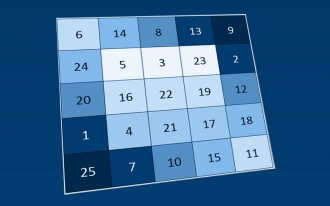
1. The Schulte table — 5 minutes every morning
It's a 5×5 grid with the numbers 1 to 25 scrambled. The task is simple: find every number in order without moving your eyes.
- Hold the table at arm's length.
- Look at the centre cell and try not to let your gaze wander.
- Find the numbers with your peripheral vision, from 1 to 25.
- Time yourself. A working target for an adult is staying consistently under 40 seconds.
What it gives you: a wider field of perception and the habit of holding focus on one point while there's noise around you. I covered the mechanics in more detail in the article on perception and Schulte tables.
2. The Stroop effect: name the colour, not the word
The word "blue" is printed in red. Your job is to say "red". The brain resists: reading is automatic, while naming the colour takes conscious effort.
That's exactly what gets trained — inhibitory control, the ability to suppress an automatic response. It's the same ability that fails you when your hand reaches for the phone by itself.
Format: 2–3 minutes, ideally in the afternoon when attention dips.
The best way to improve your result is practice. Start with the Schulte Color trainer →
3. The single-object rule: 3 minutes of attention on one thing
Take anything from your desk — a pencil, a mug, your keys. Look at it for three minutes and mentally describe everything you see: the scratches, the glare, the uneven paint, the shadow underneath.
Your mind will wander. It always does. The moment you notice, calmly bring your attention back without beating yourself up. The return itself is the exercise, not some perfect silence in your head.
In the first week, three minutes feels hard: 4–6 escapes per session is typical. Two weeks in, it drops to 1–2. That's progress.
4. The 25/5 pomodoro with a one-window rule
Everyone knows the pomodoro technique, and almost everyone does it wrong: they set a 25-minute timer and leave 12 tabs, their inbox and their phone open on the desk. That isn't attention training, that's practising distraction with a stopwatch.
- One task, one window. Everything else closed, not minimised.
- Phone physically in another room. Not "face down" — out of arm's reach.
- A sheet of paper next to you: the thought "I need to reply to Elena" gets written down, not acted on.
- 25 minutes of work → 5 minutes with no screen. Water, a window, a stretch. Not the feed.
If 25 minutes is too much, start with 15. An honest 15 beats a formal 25 with three breakdowns in the middle.
5. Counting backwards: 100 minus 7
Subtract seven from 100: 93, 86, 79, 72… Out loud or in your head, down to zero. This loads working memory and attention at the same time — you have to hold a result and immediately operate on it.
Make it harder once it gets easy: subtract 13, start from 200, or count with quiet background noise. What matters is keeping the pace and logging your mistakes. Without pace the exercise turns into autopilot and stops working.
How to fit the exercises into your day: a 21-day plan
Don't try to do all five exercises on Monday. That's what everyone does — and everyone quits by Thursday.
- Week 1. Schulte only, 5 minutes every morning, before email and social media. One exercise, no heroics.
- Week 2. Schulte in the morning plus one honest pomodoro a day.
- Week 3. Add Stroop and backward counting for 3 minutes each during your slump — usually 2–4 pm. Do the single-object exercise in the evening instead of scrolling.
That's 15–20 minutes a day in total. Less than the average person spends on their phone before lunch. If you want variety, pick other attention trainers and rotate them so your brain doesn't settle into one format.
Tips: what strengthens concentration and what kills it
What helps:
- 7–8 hours of sleep. Chronic sleep debt damages sustained attention more than any exercise can make up for.
- Water. Dehydration of just 2% of body mass already measurably drags down attention and reaction speed.
- Movement. Twenty minutes of brisk walking before a hard task works better than a third coffee.
- One task in focus. Multitasking isn't a superpower — it's fast switching with a penalty at every step.
- Silence or a monotonous background. Music with lyrics competes with you for the same verbal resources in the brain.
What gets in the way:
- A phone on the desk. Even switched off it eats part of your capacity: the brain spends effort ignoring it.
- Notifications. One pop-up and you're in a different context, with 23 minutes to climb back.
- The morning feed. You hand your freshest attention of the day to someone who isn't paying you for it.
- Grinding until 2 am. The next day will cost you more than whatever you managed to finish.
Read also: habits for better concentration — how to lock the result into your daily routine.
Mistakes that stop concentration exercises from working
- Starting with all five exercises at once. Five exercises on day one equals zero exercises on day four. Take one.
- Training "when there's time". There will never be time. Attach the exercise to an existing habit: after coffee, before the first email.
- Not measuring the result. Without numbers you won't see progress and you'll quit. Log your Schulte time and how many times you broke focus during a pomodoro — even in your phone's notes app.
- Training attention while ignoring your environment. You can do Schulte every day, but if the phone lies next to you buzzing, there'll be no effect. Exercises don't cancel out the chaos around you.
- Quitting on day ten. For the first two weeks it feels like nothing is changing. Changes usually become noticeable in week 3 — exactly when most people have already given up.
Frequently asked questions
How long does it take to see results?
The first shifts show up after roughly 2–3 weeks of daily 10–15 minute sessions. What changes first isn't the feeling but the numbers: your Schulte time, your error count, how long you can work without breaking focus.
Can you train attention after 40?
Yes. Neuroplasticity stays with you for life; progress is simply a little slower after 40. Consistency matters more than age: 10 minutes daily beats one hour once a week.
Do these exercises help with ADHD?
They can be a useful supplement, but they don't replace diagnosis and treatment. If attention problems are seriously disrupting your work, studies or daily life, that's a question for a doctor, not for a trainer.
Which is better: an online trainer or paper?
For the brain there's almost no difference — the exercise itself is what works. Online is more convenient because it counts your time and errors for you, so progress is visible in numbers. The downside is the temptation of the phone. If you have a choice, train on a computer.
Regular training gives the best effect. Try the Odd Number trainer today →
Conclusion
Concentration exercises work not because they're clever, but because they give the brain back a forgotten habit: holding one thought for longer than thirty seconds. The Schulte table, the Stroop effect, three minutes on an object, an honest pomodoro and mental arithmetic — that set is enough to get moving.
Start with one exercise tomorrow morning. Time yourself, write the number down. Compare it three weeks later and you'll see whether it works for you.